




Seyed Hashem Moosavi
Introduction
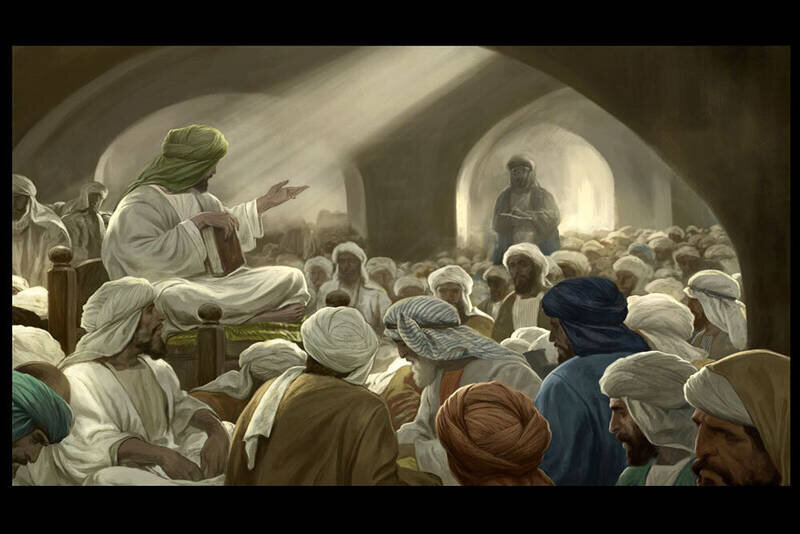
Imam Muhammad al-Baqir (peace be upon him) established a profound and systematic scholarly movement during a sensitive period of Islamic history, playing a foundational role in rebuilding religious knowledge and Shi’a identity. The “Scholarly School of Imam al-Baqir (A.S.)” was not merely a collection of study circles , but a comprehensive model for religious education , grounded in the connection between knowledge and ethics, religious rationality, training responsible individuals, and responding to the needs of the time.
This article seeks to demonstrate the potential of this model for addressing the challenges of religious education in the contemporary world , by explaining the historical context of the School’s formation, examining its epistemological and educational principles, and analysing the narrations of Imam al-Baqir (A.S.).
The Necessity of the Discussion
Religious education in the contemporary world faces multiple challenges:
- On the one hand, there is the risk of religion becoming superficial and being reduced to a collection of scattered information and rigid rituals.
- On the other hand, there is a disconnect between religious knowledge and ethical/social life , which prevents religion from becoming practical wisdom.
- Furthermore, confronting new scientific achievements (such as empirical sciences, psychology, and sociology) , secular philosophical approaches, ethical relativism, and the inability to present a coherent and interactive narrative of religion with the findings of modern sciences are other serious obstacles.
- In many religious educational systems, an excessive focus on memorizing texts, without cultivating rational thought, critical thinking, and a living ethics, has led to the production of a generation of less effective, shallow, or even religion-averse religious individuals.
- Finally, the emergence of digital media and the collapse of traditional religious authorities (the seminary and the university) have provided a vast amount of unverified, superficial, or biased religious content. This sacrifices depth of thought for speed and momentary appeal , leading to the educational content’s failure to align with the actual needs of contemporary life and major social challenges.
In such an environment, a re-reading of the authentic models of religious education in Islamic history, especially the experience of the Ahl al-Bayt (A.S.), is an inevitable necessity. The Scholarly School of Imam Muhammad al-Baqir (A.S.) is one of the most prominent of these models ; a School that, in conditions of political repression and without reliance on outward power, managed to establish the intellectual and educational foundations of Shi’ism through “Guidance-Oriented Knowledge“. This article seeks to demonstrate that this School is not just a historical phenomenon, but a living model for religious education today.
- Historical Context of the Formation of Imam al-Baqir’s Scholarly School
1-1. The Political and Social Conditions of the Imam’s Era
Imam al-Baqir (A.S.) lived during a period when the Umayyad government was facing internal instability and a financial crisis caused by its discriminatory and racist system (especially the discrimination between Arabs and Mawali). Following the tragedy of Ashura and the suppression of the Alawite uprisings, the Islamic society was grappling with a crisis of legitimacy, religious distortion, and the spread of deviant intellectual schools.
- On one hand, court jurists interpreted religion in service of power , distorting foundational concepts like Jihad, Wilayah (guardianship), and Justice, and promoting the ideology of predeterminism (Jabr) to deem any protest against oppression as against religious law.
- On the other hand, emerging intellectual currents, such as the extremists in rationalism (Qadariyyah and Mu’tazila) or those who surrendered to predeterminism (Murji’ah and Jabariyyah), pitted reason against revelation , causing Islamic thought to deviate from its balanced state.
This intellectual turmoil exposed society to discord and religious aversion. In such circumstances, society desperately needed an authoritative, independent, and salvific scholarly reference —an authority that could save religion from distortion and respond to the intellectual and ethical needs of the people. This authority needed to possess “scholarly comprehensiveness” to reconnect reason and revelation, and knowledge and action. By dividing the sciences (explaining Fiqh (jurisprudence), Kalam (theology), Tafsir (exegesis), and ethics within a coherent system) , it needed to lay the foundation for an intellectual movement whose depth and independence would ensure the continuity of the path of the Ahl al-Bayt (A.S.) against the oppressive governments.
The clear example of this scholarly authority manifested in the debates of Imam al-Baqir (A.S.). When confronting the renowned jurists of the era, such as Qatadah ibn Di’amah (who represented a current that acquired its knowledge based on general, non-Imami standards and deemed itself independent of the Household of the Prophet) , the Imam would refer the jurists back to the authentic source of the Ahl al-Bayt (A.S.) by posing key questions about the origin and authority of knowledge , demonstrating that any knowledge not originating from this mine would lead astray. These debates were a movement to reclaim the status of knowledge from corrupt governing and intellectual establishments, returning it to its true source.
1-2. The Transition of Shi’ism from “Survival” to “Explanation”
Prior to the era of Imam al-Baqir (A.S.), a significant portion of the Shi’a effort was devoted to preserving the mere existence of Shi’ism. In this stage, which involved severe political and social pressure from the Umayyads, the main priority was focused on preserving the legacy of Wilayah and the oral, hidden transmission of the principles of belief to prevent the complete annihilation of the Shi’a identity.
However, with the relative opening of the intellectual space due to the Umayyad government’s instability, Imam al-Baqir (A.S.) elevated this stage to a higher one : the stage of explanation, systematic teaching, and the production of religious knowledge. During this period, the Imam utilized the opportunity for political breathing room to not only preserve knowledge but also to organize its content, respond to the doubts of emerging intellectual currents, and train a generation of specialists.
It is from here that one can speak of the “Scholarly School of Imam al-Baqir (A.S.)” – a School that was not a simple educational space, but a strategic institution tasked with transforming the knowledge of the Ahl al-Bayt from a state of oral and hidden transmission into a codified and explained epistemological system. This strategic action paved the way for the unparalleled scholarly flourishing and the Golden Age of Shi’ism during the time of his son, Imam Sadiq (A.S.).
- Knowledge in the View of Imam al-Baqir (A.S.): Knowledge for Guidance and Insight
One of the most fundamental principles of the School of Imam al-Baqir (A.S.) is the correct definition of knowledge. In the Imam’s view, knowledge is neither a tool for boastfulness nor a means for intellectual domination ; rather, knowledge is a tool for guidance and action.
By establishing a clear distinction between instrumental knowledge and guidance-giving معرفت, Imam al-Baqir (A.S.) states:
«مَن طَلَبَ العِلمَ لِيُباهِيَ بِهِ العُلَماءَ أو يُمارِيَ بِهِ السُّفَهاءَ أو يَصرِفَ وُجوهَ النّاسِ إلَيهِ فَلْيَتَبَوَّأْ مَقعَدَهُ مِنَ النّار»; “Whoever seeks knowledge to boast about it to the scholars, or to dispute with the fools, or to turn the faces of people toward himself, let him prepare his seat in the Fire (of Hell).” (Al-Kafi, vol. 1, p. 46) .
In this view, knowledge is severely condemned due to its direction , being a tool for gaining fame (لِيُباهِيَ بِهِ العُلَماءَ), power (لِيُمارِيَ بِهِ السُّفَهاءَ), and wealth and status (لِيَصرِفَ وُجوهَ النّاسِ إلَيهِ). This type of knowledge is the very tool that Umayyad court jurists used to justify oppression.
This narration clearly shows that the intention and orientation of knowledge hold central importance in the School of Imam al-Baqir (A.S.). Knowledge separated from sincerity and ethical responsibility is not only useless, but is a gateway to religious and social deviations.
In contrast, the school of the Ahl al-Bayt (A.S.) introduces knowledge as the lamp of guidance and insight, as narrated from Imam Sadiq (A.S.):
«العالِمُ بزمانِهِ لا تَهجُمُ عَلَيهِ اللَّوابِس»; “The true scholar is one who knows his time, and doubts and intellectual turmoil will not overwhelm him.” (Tuhaf al-‘Uqul, p. 286).
This “knowledge of one’s time” includes a correct understanding of social harms, political seditions, and the genuine needs of the people. Therefore, knowledge in this perspective is a power for enlightenment and responsible social action, not merely the accumulation of information. This principle remains a serious necessity for contemporary religious education in training a “discerning” and “active” scholar.
- The Link Between Knowledge and Ethics in Imam al-Baqir’s School
In the Scholarly School of Imam al-Baqir (A.S.), knowledge without ethics is not considered knowledge at all. The Imam repeatedly warned about the danger of the “scholar without practice”. The goal of religious education in this School is to train a righteous and responsible person, not merely to transfer scientific data , because an unpractised scholar is not only misguided but also carries a multiplied responsibility for the deviation of society.
In the view of Imam al-Baqir (A.S.), knowledge must lead to fear of God (Khashiyat) and righteous deeds:
«إنّما العِلمُ ما عُمِلَ به»; “Knowledge is only what is acted upon.” (Tuhaf al-‘Uqul, p. 297).
This means that knowledge that does not manifest in the scholar’s daily behaviour, social ethics, and responsibility is fundamentally outside the definition of true knowledge. This perspective today offers a serious answer to the crisis of duality between “religious knowledge” and “religious behaviour” – a crisis rooted in the separation of educational content from ethical requirements , which has caused religion to be reduced merely to a collection of theoretical memorizations.
- Rationality and Dialogue: The Educational Pillars of Imam al-Baqir’s School
In the era of Imam al-Baqir (A.S.), some currents (such as the Jabariyyah and Murji’ah) completely rejected reason, emphasizing only the apparent text or predeterminism. In contrast, others (such as the Ghulat or some theologians) had turned reason into a tool for personal interpretations and undermining revelation.
Against these currents, the School of Imam al-Baqir (A.S.) introduced reason as the tool for understanding, extracting, and explaining revelation, not its rival. From this perspective, rationality became the backbone of Ijtihad (independent reasoning) and a deep understanding of religion.
It is on this basis that one can state that one of the distinct features of Imam al-Baqir’s School was the promotion of religious rationality and scholarly dialogue. The Imam not only was unafraid of questioning, but encouraged it , positioning reason as the internal tool for understanding religion and the complement to revelation , opposing both the extremists in narration and the compromisers in reason.
It is narrated in a tradition:
«تَذاكُرُ العِلمِ دِراسَة»; “Scholarly discussion and active review of knowledge is the very act of education and learning.” (Al-Kafi, vol. 1, p. 41).
Discussion, dialogue, and the exchange of ideas held a special place in the School of Imam al-Baqir (A.S.). This promotion of deep, participatory learning moved students beyond the mere memorization of texts and prepared them to actively confront doubts.
The Imam engaged in debates with various intellectual currents-from the Khawarij and Murji’ah to the People of the Book-but always insisted on logic, respect, and reasoned argument. This approach is an inspiring model for religious education in the contemporary world – a world where interfaith and intercultural dialogue has become an inevitable necessity , and where overcoming superficiality and fanaticism requires the rebuilding of an ethics of scholarly dialogue based on logic and mutual respect.
- Challenges of Contemporary Religious Education and the Responses of Imam al-Baqir’s School
| Contemporary Challenges | Responses of Imam al-Baqir’s School |
| Focus on memorization and credentialism | Problem-oriented education |
| Disconnect between knowledge and action | Committed and Guidance-Oriented Knowledge |
| Weakness in ethical education | Linking knowledge with purification (Tazkiyah) |
| Inability to respond to new doubts | Rationality and Knowledge of the Time |
- Practical Inspirations for Today’s Religious Education System
Based on the School of Imam al-Baqir (A.S.), several strategic principles can be extracted for contemporary religious education:
- Redefining the Goal of Religious Education: Training a faithful, aware, and responsible person.
- Balancing Knowledge and Ethics in curricula.
- Training Teachers at the level of ethical and intellectual mentors.
- Openness to Dialogue and Rationality.
Conclusion
The Scholarly School of Imam Muhammad al-Baqir (A.S.) is a model that transcends its time – a model demonstrating that sustainable religious transformation is shaped not by political pressure or isolation , but by deep education, ethical training, and guided rationality.
A re-reading of this School can be a sure path to rebuilding religious education in the contemporary world ; an education that keeps religion alive, effective, and responsive to the needs of modern humanity.