




Seyed Hashem Moosavi
Introduction: Today’s Youth and the Forgotten Question of “Why?”
Today’s young person stands before more choices than ever before, choices about life paths, identity, lifestyle, and even the meaning of existence itself. Vast opportunities, apparent freedoms, and unprecedented access to information have all emerged alongside a quiet yet widespread phenomenon: an identity crisis.
Many young people do not suffer from a lack of options, but from a lack of purpose. Simple yet fundamental questions remain unanswered: Why do I live? What is truly worth standing for? Is death a failure, or a passage to something beyond?
The Holy Qur’an traces the root of this confusion to a worldview that sees life as pointless, when a person assumes creation has no purpose. As the Qur’an asks: «أَفَحَسِبْتُمْ أَنَّمَا خَلَقْنَاكُمْ عَبَثًا وَأَنَّكُمْ إِلَيْنَا لَا تُرْجَعُونَ؛ “Did you think that We created you without purpose, and that you would not be returned to Us?” (Surah al-Mu’minun, 23:115)
In such a climate, revisiting Ashura is not merely a historical or ritual act; it is a return to a living school of meaning and identity. Among the figures of Ashura, the personality of Ali Akbar, the noble son of Imam Husayn (peace be upon them both), stands out in a special way. His life offers a vivid and contemporary response to the crisis of meaning faced by today’s youth, a young man who stepped onto the battlefield not driven by raw emotion, but by conscious faith, clarity of purpose, and deep spiritual insight.
The Crisis of Meaning: The Hidden Struggle of Today’s Youth
Meaning: A Fundamental Human Need
A human being can survive with very little in terms of material resources but cannot endure life without meaning. Meaning is the answer to the question “Why do I live?” Contemporary psychology also confirms this truth: a person deprived of meaning, even when surrounded by comfort and prosperity, inevitably suffers from anxiety, depression, and deep inner exhaustion.
The Holy Qur’an equates the loss of meaning with collapse, not merely moral decline, but existential disintegration. It declares: «وَمَا خَلَقْنَا السَّمَاءَ وَالْأَرْضَ وَمَا بَيْنَهُمَا لَاعِبِينَ؛ “We did not create the heavens and the earth and all that is between them in play.” (Surah al-Anbiya’, 21:16)
In other words, when life is perceived as a game without purpose, the human being gradually loses his inner coherence and direction.
Signs of the Crisis of Meaning in Today’s Youth
- Chronic lack of purpose
- Escaping solitude through excessive entertainment
- Anxiety about the future
- Inability to endure hardship and pain
- A deep and pervasive fear of death
This crisis is neither purely moral nor merely economic. At its core, it is a crisis of direction, a crisis of meaning.
Ali Akbar (peace be upon him): A Young Man with a Clear Identity and a Conscious Choice
Ali Akbar (peace be upon him) stands at the heart of an immense crisis, one far deeper than the crises faced by young people today. Before him lies not merely the possibility of death, but the certainty of martyrdom. Yet his response to death is neither anxiety nor hesitation.
Fear of death is often the product of a life without purpose or meaning. A person who does not know why they live, who has no clear destination, naturally fears the end, because every step forward feels like a step closer to the edge.
For someone who reduces all meaning to material comfort and daily routine, death signifies the end of everything. That ending feels unbearably painful, because it leaves behind a deep sense of incompleteness. A person who has no goal greater than the self constantly feels as though they have “not even begun yet.” For such a person, death is a thief, stealing the chance to finally discover meaning.
The Qur’an radically transforms the way we look at death. From the Qur’anic perspective, fear of death arises from two roots: ignorance of the true nature of existence, and attachment to a limited, worldly life.
The Qur’an does not describe death as annihilation, but as tawaffī, the complete receiving of the soul by the angels. For one whose purpose in life is movement toward God, “Indeed, we belong to God, and to Him we shall return” death is not a bitter ending, but a moment of meeting, a return to the true destination.
In Surah al-Jumu‘ah (verses 6–7), the Qur’an addresses those who claim to be God’s chosen ones yet fear death, saying: «قُلْ یَا أَیُّهَا الَّذِینَ هَادُوا إِنْ زَعَمْتُمْ أَنَّکُمْ أَوْلِیَاءُ لِلَّهِ مِنْ دُونِ النَّاسِ فَتَمَنَّوُا الْمَوْتَ إِنْ کُنْتُمْ صَادِقِینَ؛ “Say, O you who are Jews, if you claim that you are allies of God to the exclusion of others, then wish for death, if you are truthful.”
It then explains the reason for their fear: «بِمَا قَدَّمَتْ أَیْدِیهِمْ؛ “Because of what their own hands have sent ahead.”
That is, because of meaningless deeds and sinful actions. This makes clear that righteous, purposeful action gives life meaning and removes the fear of death.
In contrast, Ali Akbar (peace be upon him) does not see death as a threat, but as a measure of the truth of the path. His courage does not arise from youthful recklessness or indifference to life; it is the product of absolute clarity of purpose. He knows precisely why he lives and where he is going and therefore does not fear the end of the road.
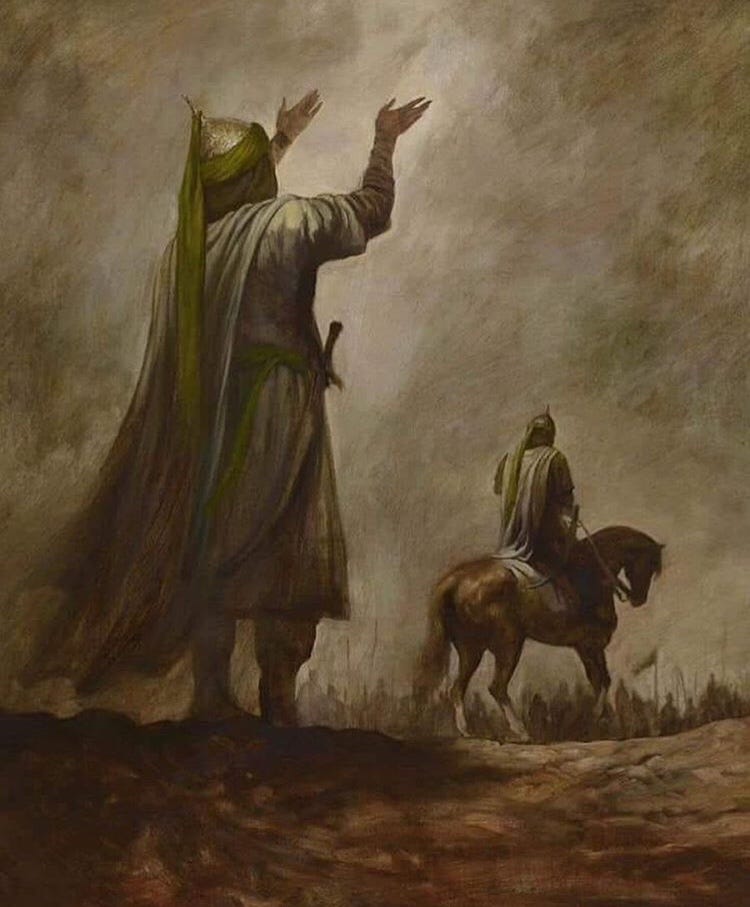
This entire worldview is revealed in a brief yet deeply moving dialogue between him and his father. On the journey to Karbala, Imam Husayn (peace be upon him) awakens from a short sleep and recites: «إِنَّا لِلّهِ وَ إِنَّا إِلَیْهِ رَاجِعُونَ»، “Indeed, we belong to God, and to Him we shall return.” With remarkable calm, Ali Akbar asks his father why he recited this verse. The Imam replies: “My son, I fell asleep briefly and saw a rider who said: ‘These people are moving, and death is moving toward them as well.’ I understood that this was news of our death.”
At this decisive moment, Ali Akbar asks a single, foundational question, one that reveals the depth of his awareness: «أَوَ لَسْنَا عَلَى الْحَقِّ؟؛ “Are we not upon the truth?”
Imam Husayn answers firmly: «بَلَى وَالَّذِي إِلَيْهِ مَرْجِعُ الْعِبَادِ؛ “Yes, by the One to whom all servants return, we are upon the truth.”
Ali Akbar then utters a sentence that distils the essence of life and death: إِذًا لَا نُبَالِي أَنْ نَمُوتَ مُحِقِّينَ “Then we do not mind dying while we are in the right.”
At that moment, Imam Husayn prayed for him: “May God grant you the best reward that a son can receive from his father.”
This statement is not merely a heroic slogan; it is the outcome of a complete worldview. Ali Akbar does not see life as the ultimate goal, but as a preparation for fidelity to truth. In his understanding, the value of life lies not in remaining, but in being on the right path. Death becomes frightening only when a person does not know what they have lived for. But for someone whose every moment is filled with meaning, death is simply a passage from one stage to a higher one.
The courage of Ali Akbar is the courage of someone who feels no inner incompleteness. He is not someone who has “not yet begun”; rather, he has reached the fullness of what he was meant to be. That is why death is not a “thief of meaning” for him, it is proof of meaning itself.
In the logic of Ali Akbar, a purposeless life is more terrifying than death, and a death on the path of truth is life in its truest sense. This is precisely the logic the Qur’an teaches: fear of death is born from attachment to a limited world and rootless actions, while serenity in the face of death is the fruit of a righteous, purposeful, and God-centred life.
Conscious Faith: The Pillar of Ali Akbar’s Identity (peace be upon him)
In the Qur’anic worldview, faith (īmān) is not a static, purely mental belief. It is a driving force, a way of seeing that gives direction to life. To understand this more clearly, faith can be likened to light. Light is not only something that is seen; by means of it, everything else becomes visible, and the path forward is revealed.
A believer does not see the world as a series of random events, but as signs (āyāt) and manifestations of divine wisdom. This perspective grants life both meaning and psychological security. When faith enters the heart as a lived insight, it immediately raises a practical question: What should I do? That is why, in the Qur’an, faith is almost never praised without righteous action. Faith with no behavioural outcome is, in effect, not faith at all.
Numerous verses emphasize that faith is a direction-giver and a life-changer. Verse 257 of Surah al-Baqarah clearly shows that faith transforms a person’s very mode of existence: «اللَّهُ وَلِیُّ الَّذِینَ آمَنُوا یُخْرِجُهُمْ مِنَ الظُّلُمَاتِ إِلَى النُّور؛ “God is the Guardian of those who believe; He brings them out of darkness into the light.”
This verse reveals that faith is an act of relocation. The believer is transferred from a space of ambiguity, confusion, and purposelessness (darkness) into a space of clarity and direction (light).
Likewise, in Surah al-Anfal (8:24), the Qur’an declares: «یَا أَیُّهَا الَّذِینَ آمَنُوا اسْتَجِیبُوا لِلَّهِ وَلِلرَّسُولِ إِذَا دَعَاکُمْ لِمَا یُحْیِیکُمْ؛ “O you who believe, respond to God and the Messenger when he calls you to that which gives you life.”
Here, the call of faith is described as a call to life. From the Qur’anic perspective, a person without faith is considered dead, even if biologically alive. This “life” is the insight that empowers a person to move forward and to choose rightly.
In Islamic thought, faith is a conscious commitment. It frees a person from countless small and humiliating attachments and binds them to a single, great truth. As the Qur’an states: «مَن کَانَ یُرِیدُ الْعِزَّةَ فَلِلَّهِ الْعِزَّةُ جَمِیعًا؛ “Whoever seeks honour, then all honour belongs to God.”
One who connects to God becomes ‘azīz, dignified, resilient, and inwardly strong. Such a person is truly free, because they are no longer moulded by social pressure or external forces that seek to redefine their identity.
In summary, faith in the Qur’an is a new lens through which the world becomes meaningful, and a roadmap that guides one’s steps through moral and existential darkness.
The serenity of Ali Akbar (peace be upon him) is born of precisely this kind of faith. He is the son of an Imam, yet his faith is not an inherited, habitual, or unexamined belief. It is a chosen and understood faith. His question to his father is a clear sign of this awareness, a question asked not out of doubt, but out of the desire for certainty.
His question resembles that of Prophet Abraham (peace be upon him), when he asked God: “My Lord, show me how You give life to the dead.” God asked, “Do you not believe?” Abraham replied, «ولکن لیطمئن قلبی؛ “Yes, but so that my heart may be at peace.” In the same way, Ali Akbar (peace be upon him) seeks assured certainty. He wants to experience the truth of the path with his entire being, so that the tremors of crisis cannot disturb his inner calm.
This is conscious faith: a faith that steadies the heart before the storm, clarifies the path amid uncertainty, and anchor’s identity in truth rather than circumstance.
Ali Akbar (peace be upon him) and Today’s Youth: An Educational adaptation
The difference between eras is undeniable, but the questions remain the same. Today’s young person, too, stands at a crossroads between truth and falsehood, meaning and emptiness, conscious choice and passive drift.
The message of Ali Akbar (peace be upon him) is that the arena does not have to be a battlefield. Every day is an arena in which meaning is chosen. To attain inner calm amid life’s storms, one must move beyond inherited, identity-card beliefs and reach the level of chosen and lived certainty.
In this worldview, success is neither wealth nor fame; it is fidelity to meaning. Ali Akbar (peace be upon him), though described as the one who most resembled the Prophet in appearance and character, is truly remarkable not merely for this resemblance, but because he preserved it through conscious will and remained loyal to the meaning of his life.
In the logic of the Qur’an, being the son of Noah was not enough for salvation; rather, “unrighteous action” severed the bond of blood. By contrast, Ali Akbar (peace be upon him) bound his biological lineage to an ideological and moral commitment. Blood ties alone did not define him, chosen values did.
Conclusion: Ashura, A School of Meaning for Today’s Generation
Ashura is not merely a narrative of tears and sorrow; it is a map of meaning. Ali Akbar (peace be upon him) embodies a form of youth who:
- Thinks with awareness
- Chooses freely
- Lives with faith
- And dies with meaning
He is not a model of blind or unthinking commitment; he is a model of the conscious, choosing believer.
In a world where the crisis of meaning has stolen inner peace, returning to Ashura is a return to answers, answers that tell us: when meaning is clear, even death loses its terror.