


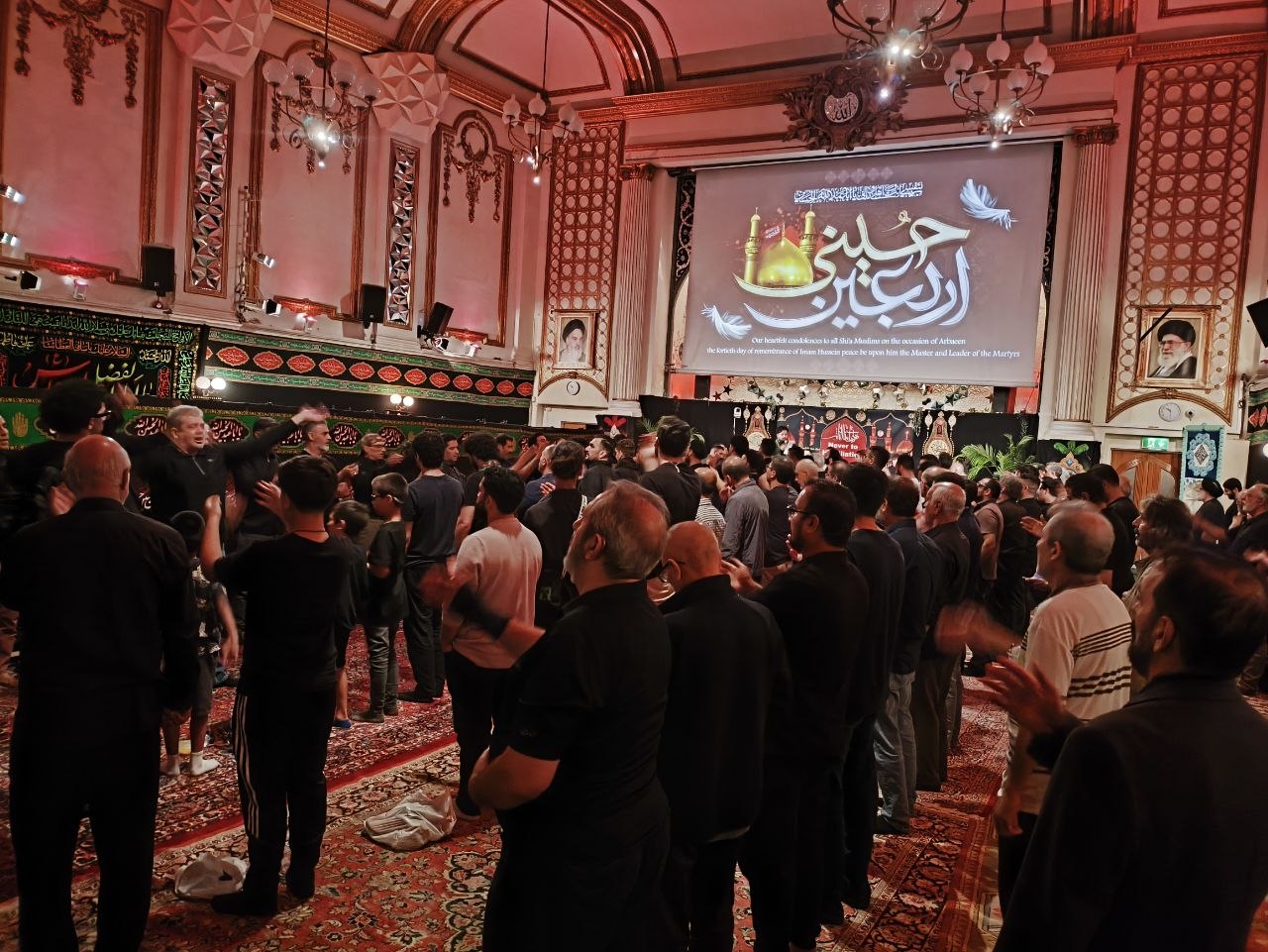


Hundreds of Shia Muslims and followers of the Ahl al-Bayt (a) gathered at the Islamic Centre of England from 3 to 5 August 2026 to commemorate Arbaeen, with programmes held in Persian, Arabic and English.
The commemorations focused on the meaning of the Arbaeen pilgrimage and its role in preserving the message of Ashura and transmitting it from one generation to the next.
Speaking during the programme, Hujjat al-Islam wal-Muslimeen Seyed Hashem Moosavi, Imam of the Islamic Centre of England, highlighted the importance of ziyarat within the teachings of the Ahl al-Bayt (a), particularly the tradition of walking to visit Imam Hussain (a).
He said the Imams (a) repeatedly encouraged their followers to visit Imam Hussain (a), describing ziyarat as an expression of love, loyalty and renewal of one’s covenant with the friends of Allah.
Drawing on narrations from Imam al-Ridha (a), Imam al-Sajjad (a), Imam Muhammad al-Baqir (a) and Imam al-Sadiq (a), Seyed Hashem Moosavi said the emphasis placed on the visitation of Imam Hussain (a), especially during Arbaeen, reflects its important role in strengthening faith, religious identity and attachment to the path of the Ahl al-Bayt (a).
A central theme of his address was the idea of “bearing witness”.
Referring to the repeated use of the word ashhadu — “I bear witness” — in the Ziyarat of Arbaeen, he said the tragedy of Ashura was an event whose perpetrators sought to suppress and erase its truth.
Arbaeen, he explained, ensured that this would not happen.
“The Muslim Ummah must remain a witness to the truth of Ashura,” he said, adding that when there are no witnesses, history can be shaped by those who hold power.
Seyed Hashem Moosavi also pointed to the decisive role played by Lady Zaynab (s) after the tragedy of Karbala.
He said her mission went beyond patience and endurance in the face of immense suffering. By publicly recounting what had taken place and confronting those responsible, she became a witness to the truth of Karbala and ensured that the message of Imam Hussain (a) could not be silenced.
Citing the Qur’anic verse, “so that you may be witnesses over mankind” — لِتَكُونُوا شُهَدَاءَ عَلَى النَّاسِ — he said Islam places a wider responsibility on the Muslim community to stand as witnesses to truth, justice and divine values.
Arbaeen, he said, renews that responsibility each year by keeping the memory of Ashura alive and reminding new generations of their duty to oppose oppression and stand with justice.
He described the Arbaeen Walk as a practical expression of this witness, saying the journey towards Karbala is more than an act of devotion.
It is, he said, a public declaration of loyalty to the ideals of Imam Hussain (a) and a living testimony that the message of Ashura remains alive.
Seyed Hashem Moosavi also identified three key dimensions of the Arbaeen pilgrimage: recognising the Imam, understanding the meaning of his life and martyrdom, and committing oneself in practice to the values of the Ahl al-Bayt (a).
He stressed that ziyarat reaches its fullest meaning when it does more than create emotional attachment, and instead inspires people to support truth and take responsibility for upholding divine values.
The Arabic and English programmes also featured lectures by Hujjat al-Islam wal-Muslimeen Shaykh Usama al-Attar, who spoke on the virtues and philosophy of the Arbaeen pilgrimage.
The commemorations included mourning recitations and elegies in Persian and Arabic, as well as congregational Maghrib and Isha prayers led by Seyed Hashem Moosavi.