


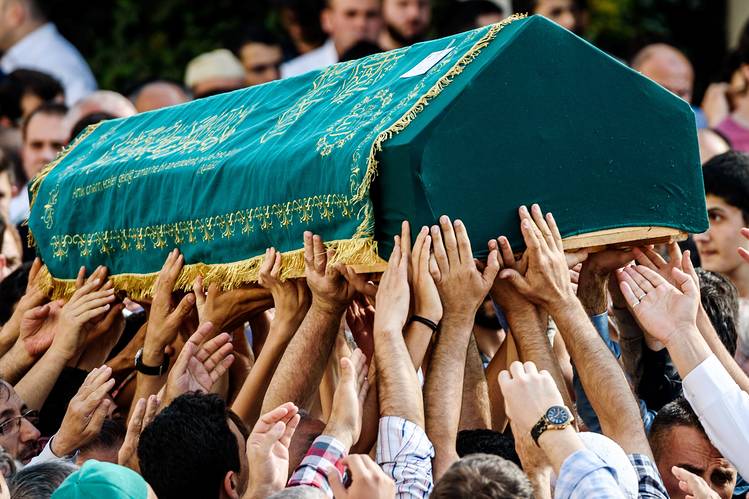


A reflection on the philosophy of funeral processions in Islamic culture and their role in sustaining the path of the righteous and the martyrs
Seyed Hashem Moosavi
Introduction
At first glance, death is the most individual and inevitable experience in every human life. It is an event in which all of a person’s material ties with the surrounding world are severed, and the human being stands alone before the presence of Almighty God in the most exposed form of existence. The Holy Qur’an repeatedly emphasizes this individual and solitary dimension, saying: «وَکُلُّهُمْ آتِیهِ یَوْمَ الْقِیَامَةِ فَرْدًا؛ “And every one of them will come to Him on the Day of Resurrection alone” (Surah Maryam, verse 95).
Islamic law, too, in many of its duties and acts of worship, calls the individual to seclusion, hidden and nocturnal supplication, and the cultivation of a deeply personal and direct relationship with the Lord. The night prayer, spiritual retreat, and prolonged prostrations in the darkness all point to the essential role of solitude in the spiritual perfection of the human being.
Yet the wonder of Islamic law lies in the fact that precisely at the moment when this most individual event of life-death-takes place, it suddenly changes direction and brings it out from the private chamber of solitude into the public arena of society, the streets, and the neighbourhood. Why does a law that emphasizes concealing acts of worship call society into the field when a believer dies, insisting on collective presence, audible proclamation, tangible solidarity, and a communal farewell? Why do the instruction of the dying person, washing, shrouding, the funeral prayer, the funeral procession, burial, condolence, visiting the grave, and remembering the dead-all of which are social acts-become matters of immediate concern after this individual event occurs?
The answer to this question opens a new horizon in Islam’s sociology of knowledge: a horizon in which death is not merely a biological and individual ending, but a profoundly social, educational, and manifesto-like event for awakening the living.
The Dual Dimensions of Death: From Individual Severance to the Educational Awakening of Society
In Islam, death is not a one-dimensional phenomenon. Although the soul of the deceased begins an individual journey, the body and memory of the person become an educational asset for society. In the social psychology of Islam, society is a single body-«کالجَسَدِ الواحد» “like one body.” The death of one member is an injury to this body, but through the prescribed rites for the dead-washing, shrouding, prayer, and procession-Islamic law transforms this loss into an opportunity for spiritual and moral renewal for the whole community.
The funeral procession is one of the most important collective actions of Muslims and helps consolidate the identity of the ummah. When a person passes away, the presence of people at the funeral procession declares that, in an Islamic society, the individual is not abandoned: his life was honoured, and his death is honoured as well. This collective act repairs social fractures and, regardless of the deceased person’s social class, wealth, or status, places everyone equally before the stark reality of death. In truth, attending a funeral procession draws society out of the heedlessness of daily routine and directs it toward a station of collective reflection.
The Close Link Between Funeral Processions and Visiting the Sick: A Manifestation of Mutual Rights and Solidarity
In the traditions of the Infallibles (peace be upon them), a system of mutual rights among Muslims is defined. In a well-known narration from the Noble Prophet (peace and blessings be upon him and his family), he is reported to have said: «لِلْمُسْلِمِ عَلَى أَخِیهِ سِتَّةُ حُقُوقٍ…» “A Muslim has six rights over his brother…” Among these rights, “visiting the sick” and “following funeral processions” are mentioned side by side. This juxtaposition and overlap of rights reveals a profound philosophy.
Visiting the sick means accompanying a believing person during suffering, weakness, and illness; it is a step toward strengthening the person’s spirit and preserving the bond of life. The funeral procession is the natural continuation of that companionship. It is as if Islamic society tells its member: we were not only beside you during suffering and illness; we will not abandon you in your final passage toward the eternal abode either. This tangible bond creates a chain of psychological and emotional security within society.
This association shows that, within the shelter of Islamic culture, a human being is never abandoned or left alone. He is a member of a great family called the ummah. Society visits him at his bedside in the hope of returning him to life, and it accompanies his body to burial in order to honour him and his family. This process generates the highest level of faith-based solidarity and social capital.
The Philosophy of the Rewards and Virtues of Funeral Processions: Numerical Calculation or Educational Transformation?
A glance at the texts of hadith reveals an astonishing abundance of rewards and virtues for one who accompanies a funeral procession. For example, the Noble Prophet (peace and blessings be upon him and his family) said: “Whoever follows the funeral procession of a Muslim until the funeral prayer is performed for him will receive one qirat of reward; and if he remains until the burial, he will receive two qirats of reward; and each qirat is like Mount Uhud.” Some narrations also state that whoever accompanies a funeral procession, for every step he takes, thousands of good deeds are recorded for him and thousands of sins are erased from him. Are these virtues meant as a merely numerical and mathematical calculation? If we understand them in that way alone, we lose an important part of their wisdom. Or are these numbers symbols of the depth of the educational effect of this act?
Undoubtedly, the authentic Islamic view considers reward to be proportionate to “inner transformation” and the “quality of the act.” The virtues mentioned reflect the immense educational capacity of the funeral procession. A person walking behind a coffin is exposed to several profound spiritual transformations:
- Heavenly insight and the breaking of pride and arrogance: Witnessing the final end of the human being brings down the palaces of worldly hopes and compels a person to reflect on the truth of his own existence.
- Empathy and the softening of the soul: Sharing in the grief of the bereaved removes hardness of heart and strengthens the sense of social compassion.
- Repentance and return: Traditions emphasize that, while accompanying a funeral procession, one should imagine oneself inside that coffin, having asked God for an opportunity to return-and that the opportunity has now been granted. This mental image is one of the strongest motives for reforming one’s conduct and turning back to God.
Therefore, the immense virtues associated with funeral processions are not meaningless numbers; rather, they point to the lofty value of this educational “class,” which can, within a few hours, redirect the life of a heedless person toward righteousness and salvation. For this reason, many masters of ethics recommend that one should not neglect attending funeral processions, because what may not be achieved through hours of preaching can sometimes be gained within a few short moments by witnessing a funeral procession.
The Difference Between the Funeral Procession of Ordinary People and That of Martyrs: The Medium of Blood and Message
Although the funeral procession of every believing person has virtue and educational dimensions, the procession of martyrs, scholars, and divine leaders-the Infallibles, peace be upon them-has an essential and qualitative distinction. The funeral procession of an ordinary person is concerned more with learning lessons, seeking forgiveness for the deceased, and consoling the bereaved. The funeral procession of a martyr, however, is a heroic, political, and doctrinal act.
A martyr is not merely a person who has departed this world; he is the living message of resistance. Through his martyrdom, he has fulfilled a great mission: he has sacrificed his life for an ideal, for justice, and for truth. Yet this great self-sacrifice requires continuation. Here, the role of the people and society begins. By accompanying his purified body in procession, the community renews its pledge to the values for which the martyr gave his life, commits itself to spreading the message of his blood, and, in other words: “If the blood of the martyr is a message, his funeral procession is the medium through which that message is disseminated.”
Through his martyrdom, the martyr completes the first stage of his mission: injecting fresh blood into the half-lifeless body of society and bearing witness to the truth of the school of faith. But the second stage-conveying this message to history and to the living-begins through the ummah in the ritual of the funeral procession. The more magnificent, cohesive, and passionate the procession, the stronger this medium becomes, and the more widely the martyr’s message is transmitted across society and to future generations.
The funeral procession of a martyr revives the spirit of sacrifice, resistance, and readiness for martyrdom within society. In this ceremony, sorrow and grief are blended with epic resolve and spiritual joy. In such an atmosphere, the participant sees himself in the presence of a great exemplar and experiences a remarkable spiritual elevation, for he is bidding farewell to one who looks directly toward the Face of God. In the same way, the funeral procession of a godly scholar honours the value of knowledge and wisdom and directs society toward the pursuit of virtue.
Historical and Contemporary Funeral Processions: The Continuation of a School’s Life and the Renewal of the Ummah’s Covenant
The history of Islam, and especially the history of Shiism, bears witness to funeral processions that changed the course of history or were recorded in the memory of time as enduring signs of oppression and truth. The secret and nocturnal burial of Lady Fatimah al-Zahra (peace be upon her) was itself a deeply political and media-like act: a silent cry of protest against the deviation of the caliphate’s path, leaving forever a great question mark on the forehead of history.
The funeral procession of Imam Hasan al-Mujtaba (peace be upon him), despite the obstruction of the Umayyads, recorded forever the oppression suffered by the Ahl al-Bayt. By contrast, the magnificent funeral procession of Imam al-Ridha (peace be upon him) by the people of Khorasan manifested the overflowing emotions and loyalty of a nation toward the Household of Revelation and shook the foundations of the Abbasid government’s legitimacy.
The great Arbaeen gathering of Imam Husayn (peace be upon him) is, in truth, the continuation of that historical funeral procession, which, after centuries, still brings millions of people together on the road to Karbala.
In the present age as well, the vast and magnificent funeral processions of great leaders and martyrs-such as the immense, enduring, and unparalleled funeral procession of Imam Khomeini and the martyred Ayatollah Khamenei (may God sanctify their secrets)-displayed before the world new manifestations of this religious-political rite. This presence of millions was not merely a gathering driven by emotion and affection; as many who have spoken or written on this subject have acknowledged, it was a great street referendum and a declaration of loyalty to the ideals for which those martyrs sacrificed their lives.
In this sense, the funeral procession of a martyred leader showed that martyrdom is not the end of the road; rather, it is the beginning of a new and more dynamic stage in the social life of a school of thought. The lifeless body of the martyr, carried on the hands of millions, becomes a driving engine that strengthens national cohesion, neutralizes the plots of enemies, and guarantees the continuation of the path of resistance. This presence is a form of collective “renewal of covenant,” through which the whole society pledges allegiance once again to the thought and path of the martyr.
Final Word: The Funeral Procession as the Beginning of the Living’s Responsibility
From the perspective explored here, the funeral procession in Islamic culture is not merely the farewell of a material body toward the earth; it is the farewell to a lifetime of faith, service, struggle, and virtue. The greater and more divine the personality of the one being accompanied, the broader the educational, communicative, and civilization-building capacity of the ceremony becomes. The procession of a scholar draws attention to the lofty value of knowledge and piety; the procession of a martyr causes the spirit of heroism and steadfastness to flow through the veins of society; and the remembrance of the Ahl al-Bayt (peace be upon them) becomes the compass guiding society toward truth and justice.
Thus, in Islam, the funeral procession is not the end of a life; it is the beginning of a new responsibility for the living. By attending this rite, society commits itself to taking up the fallen banner of the deceased or the martyr and to ensuring that the ideals for which he lived and gave his life are not forgotten. The funeral procession links the yesterday of the strivers with the today of the living and the tomorrow of future generations. It is a dynamic rite that removes the dust of heedlessness from the face of society and keeps it on the path of constant vitality and awakening.